Showing posts with label townhouse. Show all posts

Wednesday, June 8, 2011

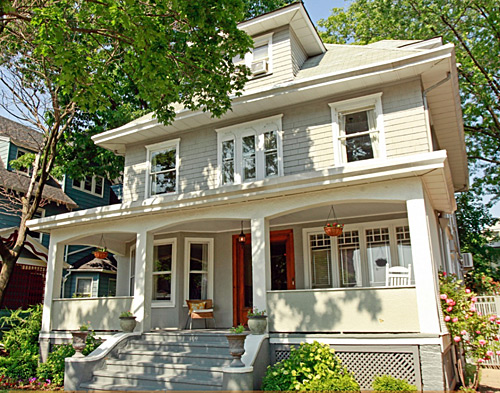
It’s Free to Look: This Is What Ditmas Park Is All About


Ditmas Park, New York's answer to suburbia. The place where all the cool kids go when they want to show that growing up in Montclair or White Plains or Brookline wasn't actually half-bad. The place where you can still walk to the subway or down to Cortelyou for killer coffee and the farmers market.


The place where a seven-bedroom Victorian wonder would once run you under $100,000. Now they're all well over a million, at least the nice ones, but it's still bliss.

See floor plan and photos at Observer.com >


Victorian quietude. High culture and low. Wood galore adorns the inner rooms...really, there's wood everywhere. It's like living in a secluded forest in Brooklyn.

Big City living with spacious rooms. A fine kitchen for a food-obsessed borough. How about this deck?

All flanked by a lush, landscaped back yard. There's even a koi pond! (Of course there's a koi pond.)

SLIDESHOW: This Is What Ditmas Park Is All About. >>

Friday, November 19, 2010

**Video Tour/New Listing** Upper East Side One Bedroom Rental - East 90S & 3rd Avenue

Upper East Side One Bedroom Apartment Rental - New Listing featuring a Video Tour!


Well maintained walk up building, original pre war detail and feel, separate eat in kitchen including appliances, tiled bathroom, large living room featuring a southern exposure view, bright apartment corner unit, large bedroom – can fit a queen size bed and extra furniture, southern and western exposure views, new hardwood floors, video intercom system, excellent Upper East Side location – 2 blocks away from the 6 line!


Shown by appointment only - JAD Realty Group 610.781.8417


Wednesday, November 3, 2010

New Listing Featuring a VIDEO TOUR - EAST 90S & 3rd Avenue - Below Market Value

Just hit the market...Upper East Side One Bedroom Rental...VIDEO TOUR...East 90S & 3RD Avenue

Well maintained walk up building, fourth floor unit, newly installed video intercom system, separate eat in kitchen including appliances, tiled bathroom, large living room featuring a southern exposure view, 12' X 12' bedroom - can fit a queen size bed and extra furniture, original prewar detail, new hardwood floors, live in super, three blocks away from the 6 line!

Shown by appointment only - beginning November 3rd!

Wednesday, October 20, 2010

Eleven Reasons People Can't Sell Their Homes


The environment for home sales becomes more difficult with each passing month. Some estimates put 11 million mortgages, about 20% of the U.S. total, underwater, meaning that homeowners owe their banks more than the underlying properties are worth. Home repossessions reached more than 100,000 for the first time in September. Rising foreclosure rates continue to further depress housing prices.

The federal government let its tax benefit for homeowners expire in April and has not renewed it since them. The program did boost sales earlier this year. Shoppers must now face a market without the credit in which many home prices continue to fall.


The clamor over flawed foreclosure paperwork and robo-signers could further chill the housing market. People who might buy have bought a home in foreclosure will now worry about obtaining proper documentation and effective transfer of title.

24/7 Wall St. spoke with experts at real estate research firms Zillow.com and RealtyTrac to find the best way to sell a home. We also interviewed management from the National Association of Realtors, a number of real estate brokers, bank managers and elected officials in affluent communities. What emerged from these conversations and our research is the following: successful home sellers often do the same small number of things correctly. Often, these tactics are the difference between finding a buyer and not.

1. Pick the Best Broker

Many people who decide to sell contact a real estate brokerage with a sterling reputation or go to one that has the largest number of listings. Frequently, when potential sellers call these firms, they are turned over to the first available broker in the office. That person is often not the best representative. As a matter of fact, what is a successful broker doing in the office anyway? There are a small number of brokers in most markets who have a better track record than their peers. Most of them have been brokers for a long time and did not lose their jobs when the housing bubble collapsed.

2. Get an Appraisal

Sellers should obtain an appraisal for their home before they put it on the market. One of the major reasons house sales fall apart is that the bank assesses the home for less than the buyer has agreed to pay. For example, a buyer and seller agree on a price of say $250,000. Then the buyer goes to his bank to get a mortgage. But, the bank appraises the house for $200,000. Now, the buyer has to put up more money. Sellers who get their own appraisals get a realistic idea of what price a bank would value a house at before they enter into a sale. Most appraisers already do some work for banks. An appraisal often tells a seller what a "safe" price is. And an appraisal's average cost is only about $200.

3. Get the Right "Comp"

Sellers must make sure that foreclosures in their area are included in the "comps" the Realtor gives them. Traditionally, a broker will give a seller a list of similar properties in the market and that information is part of what is used to set a price. What brokers do not always do is put the price of any foreclosed properties that are comparable into the calculation. A typical foreclosed home sells for 25% to 30% less than similar inventory in the same area. If sellers don't take that into consideration, their home will not be priced competitively and they put themselves at a disadvantage. Sellers wind up slashing prices after their overvalued properties are on the market for several months without success.

4. Tax Assessment

Low property taxes are critical to finding buyers. Property taxes in most cities, towns and counties have gone up for years as home values appreciated. This revenue is used to run schools and other local services. However, now home values have dropped sharply, and the appraisals by local authorities on which taxes are based are too high. Many cities have a process for homeowners to request lower appraisals, and as a consequence obtain a reduced property tax. Some states even have a board of appeals for homeowners who do not think they were treated fairly. One way for people to get local authorities to cut the tax assessment of their home is to put it on the market at below the appraised price. If the home does not sell for several months, they can present empirical evidence of the lower value. A home assessed for $300,000 that goes on the market for $275,000, but does not sell for a year, is probably not worth $300,000.

5. Conserve Utilities

Turn the lights off! Most buyers ask for utility bills. "Energy wasters" who sell a home will rue the times they forgot to turn off lights, turn down the air conditioner or left the TV on all day. It would be ill-advised to fake the amount of energy being used by simply living in the dark and cutting utility costs to nearly zero. However, careful and prudent use of energy can cut bills by enough so that a buyer does not have sticker shock about what it costs to maintain electricity, gas or oil to run a house.

6. Sell "Green"

Not very many homes are actually built with environmentally friendly material or heated by solar panels or wind. But those that are have a special appeal to the crowd that buys green cars such as the Prius. A seller may have one of only a few "green" homes in their town or city. That may make it highly desirable to many shoppers.

7. Curb Appeal

This item appears on most lists, and many sellers don't bother to take the advice to prune the hedges or clean the gutters. But it is even more complex than that. Walk to the road on which your home is located. Now walk toward the house. What does a buyer see for the first time? Most sellers never bother to look at their homes through a buyer's eyes. Do the shingles need a paint job? Are the shutters looking shoddy? "Love at first sight" is no less rare with homes than with people.

8. Everything Is Negotiable

Negotiate the fee with the broker. The fee paid to a Realtor for selling a home is traditionally 6%. Sellers often believe that they can get that down to 5% or even 4%. But, in a market where brokers are desperate for business, pressing for 3% or even 2% may work. Whatever the savings are, they can materially affect how much a seller can drop the price of his home and still walk away with a profit.

9. Get an Inspection

Sellers should do some of the inspection work and testing before their home goes on the market. Inspectors for buyers are often aggressive when they report what is "wrong" with a home to their clients. For as little as $250, an inspector will go through your house and tell you what the inspector is likely to flag such as a roof leak or old, energy-wasting windows. That gives the seller a chance to fix the problem for less than the buyer may want to lower the price by, or at least know the items that a buyer will use to negotiate down the price.

10. Hire a "Stager"

For as little at $200, you can hire someone who can make your home look better by moving pictures, furniture, lights and addressing problems that may make the home show poorly. These people are cousins to the men and women who "fix" expensive homes before magazines come in to photograph them for stories. "Stagers" have lists of tricks that few Realtors and almost no homeowners know. The "better" your home looks, the more appealing it will be to potential buyers.

11. Fix It First

Sell a house that does not need any work. In a market in which people count every penny and worry about job security, fewer buyers want homes that are "fixer uppers" that require work that could cost thousands or even tens of thousands of dollars to address. These days, a buyer choosing between two homes will most likely take the one that needs the least work. It may cost some money to get your home to the point where a buyer can walk in and do almost no work. However, it may be the difference between selling a home and having it languish on the market.

Monday, March 15, 2010

Residential rents inch up from earlier in year, but drop from last year


Citi Habitats' February market rental report found that rents inched up slightly from the previous month but fell from the same period last year (see below for full report).

According to the report, which includes only apartments leased by Citi Habitats, the average monthly rent for a studio increased 2 percent to $1,756 in February from $1,725 the previous month. Both figures are down from $1,764 in February of last year, according to Citi Habitats data.

Average rents for one- and two-bedrooms each increased 1 percent in February of 2010 from the previous month, the report found, with one-bedroom rents rising to $2,335 from $2,318 and three-bedroom rents increasing to $3,283 from $3,257. The average rent for a one-bedroom fell 3 percent to $2,405 from February of 2009, and two-bedroom rents fell 6 percent year-on-year from $3,483.

According to the report, the average rent for a three-bedroom apartment in February 2010 was $4,347, roughly on par with the previous month but down 4 percent from $4,528 last year.

Vacancy of rental apartments for February 2010 was 1.54 percent, the report found, virtually the same as January's figure of 1.59 percent. The report estimated that were approximately 10,355 available Manhattan rental apartments available at any given time in February.

Citi Habitats said it brokered "over 775 transactions" in February, but did not release the exact figure, saying it was "similar" to the number of deals it did in the same period of last year.

Manhattan's rental market is known for its lack of transparency, and the Citi Habitats data is one of several competing and often contradictory reports.


Wednesday, February 24, 2010

Manhattan rental market flat

The Manhattan rental market showed little movement this past month, according to the Real Estate Group NY's mid-month February 2010 report, with rents climbing just .19 percent since last month (see the full report below). While the rate of vacancies continued to decrease, particularly among doorman units, which saw inventory drop 9.65 percent month-over-month, the report describes the market as sluggish. "Downward seasonal pressure combined with positive market trends to hold rents flat this month," the report explained. "Yet… landlords are finding that the bottom of the market is not the reprieve they were hoping for… the rebound is likely to be a much slower process than landlords anticipated." The most expensive units on the market were non-doorman two-bedroom Tribeca apartments, which had average rents of $7,297 per month, while the lease expensive units were Harlem non-doorman studios, with an average rental rate of $1,394. These figures, are based on data cross-sectioned from over 10,000 currently available listings located below 155th Street, the report indicates.

Market Snap Shot

Thursday, February 4, 2010

Manhattan apartments see annual price decline for first time since 1996

A Prudential Douglas Elliman report released today depicts the spectacular rise of home prices over the past decade, but also the sudden -- and definitive -- arrival of the real estate slump in Manhattan.

In 2009, Manhattan co-ops and condos saw year-over-year declines for the first time since 1996, the report shows. The average 2009 apartment sold for $1.39 million, down 12.5 percent from the previous year. The median price dropped 11 percent to $850,000 from 2008, while the average price per square foot sank 14.2 percent to $1,073.

Other areas of the country have seen real estate activity and prices decline gradually over the past few years, but the Manhattan real estate market was still booming until the Lehman Brothers collapse in the fall of 2008. In fact, Manhattan prices set new records in 2008. That year, the average sale price of a Manhattan apartment reached a new ever high of $1.59 million, while the median was $955,000 and the price per square foot was $1,251, according to the report.

The number of sales sank 27.9 percent to 7,430 in 2009, from 10,299 in 2008 and 13,430 in 2007. Still, Manhattan real estate prices remain at dizzying heights compared to a decade ago.


Source: Prudential Douglas Elliman

In 2009, the median sales price of a Manhattan co-op or condo surged 113 percent from $399,000 in 2000, Elliman's report says, while the average sales price climbed 96 percent from $710,778. In 2000, the average price per square foot in Manhattan was $522, about half of what it was in 2009, the report said. "Nobody lost if they bought something in 2000," said appraiser Jonathan Miller, president and CEO of Miller Samuel and the preparer of the report.

Brokers recall watching in awe as prices began their rapid ascent in the 2000s.

"A thousand per square foot -- that's a number that I never would have imagined," said Jeff Wolk, the president of real estate brokerage Fenwick Keats Goodstein, who has been a real estate agent in the city for 20 years. He recalled being flabbergasted when Manhattan apartments started selling for $30 and $40 million in the aughts. "Thirty million dollars for an apartment?" he said. "Those are stratospheric prices. We're still talking about incredible sums, even though the market is off since the onslaught of the recession."

The aughts saw more price appreciation than either of the two prior decades, Miller said. The average sale price increased 96 percent throughout 2000s, but it grew only 26 percent in the 1990s, Miller said. While he does not have specific data for the 1980s, he estimated that prices during the decade grew more than in the 1990s but didn't match the monster increases of the 2000s, he said.

One reason for the dramatic price increase was the mid-2000's construction boom of new condominiums. In 2000, co-ops represented 60 percent of the units that changed hands, but in 2009, that percentage had shrunk to 46 percent, while condos made up 54 percent. Co-ops still represent about three quarters of the total housing stock in Manhattan, Miller said.


Source: Prudential Douglas Elliman

Because of the new construction, Manhattan's housing stock is more luxurious than it was a decade ago. "The new product that's been added to the market is larger, the mix of larger units is higher, and you have more full-service, doorman-type properties," Miller said.

Easy credit and speculation also helped fuel rising price in the last decade, he said, even in the face of 9/11 and two recessions.

"Clearly, we did have a housing bubble, and that was part of it, and we also had significant economic expansion during this period," Miller said. "A big part of it, really, was a function of credit."

In addition, New York City itself was transformed during the late 1990s and 2000s as crime rates fell.

"It's become safer and more cosmopolitan," Wolk said. Manhattan's enhanced reputation for safety has made it more desirable to foreign buyers, who in turn helped drive up real estate prices.

"We attracted a higher concentration in the aughts of foreign buyers, and I think safety was a huge element of that," Miller said.

Wolk also attributed the run-up in prices to the expansion of Wall Street during the 2000s.

"The growth of the financial markets and the huge amounts of money [it produced] has fed right into our market, no question," he said.

Areas that saw the most price appreciation over the past decade were what Miller called "fringe" neighborhoods like Harlem. For example, the average sales price of a co-op or condo in Upper Manhattan (north of Central Park) in the year 2000 was $170,332, a figure that shot up 204 percent to $519,169 by 2009.

More established neighborhoods also saw prices rise, but not to the same extent. For example, the average price of an Upper East Side co-op rose 110.2 percent to $1.49 million in 2009 from $710,299 in 2000. Condo prices in the same neighborhood grew 100 percent to $2.11 million from $1.06 million in 2000.

An anomaly in the report was Battery Park City, which saw its prices quadruple as new condos were built with much larger units than had been found in the area in the past, Miller said.

Meanwhile, townhouses saw a slow-but-steady appreciation over the decade, though their prices are also down from 2008.

The average sales price of Manhattan townhouse (defined as a one- to five-family home, delivered vacant) was $5.01 million, down 32 percent from a record $7.37 million in 2008 and up 51.6 percent since 2000. The median sales price was $3.4 million in 2009, down 31.2 percent from a record $4.99 million in 2008, and up 37.2 percent from 2000.

Because there are a limited number of Manhattan townhouses, but also a limited number of potential buyers, "you saw modest, steady growth," Miller said.

Wednesday, November 4, 2009

Brand New New York City Rentals / Below Market Value - JAD Realty Group

Brand New Rental Listings Weekly! Studios, One Bedrooms, Two Bedrooms, and Three Bedrooms. Below Market Priced Apartments. Upper East Side, Gramercy, Murray Hill, Midtown East/West, and Union Square.

Contact JAD Realty Group for current availabilities or to schedule an appointment - 610.781.8417

www.jadrealtygroup.com/JAD_Realty_Group/Home.html


Brand New Rental Listings Weekly! Studios, One Bedrooms, Two Bedrooms, and Three Bedrooms. Below Market Priced Apartments. Upper East Side, Gramercy, Murray Hill, Midtown East/West, and Union Square.

Contact JAD Realty Group for current availabilities or to schedule an appointment - 610.781.8417


Thursday, June 11, 2009

Upper East Side rents fall

 How much does it cost to live in one of the city's poshest 'hoods?

Not as much as it used to. If you're seeking a rental near many of the city's wealthiest denizens, you'll find an assortment of deals on the Upper East Side.

"Last year, if you were looking for a studio [on the Upper East Side], you couldn't find anything for below $1,500," says Dan Marrello, a managing director for Citi Habitats.

But things are different now.

"It's really unheard of that we're seeing studios at $1,000 to $1,400 -- but we are," says Adjina Dekidjiev, rental director for Manhattan Apartments. "I've got 39 [listings for] studios under $1,400 on the Upper East Side."

Of course, mansion-lined blocks aside, the Upper East Side has always been a little cheaper for renting than much of the rest of the city.

"The Upper East Side is a very established neighborhood, with every amenity you could want or need," says Gary Malin, president of Citi Habitats. "What you're missing is the transportation factor."

That's especially true of rentals along First and Second Avenues, several long avenue-blocks away from the Lexington Avenue 4/5/6 trains. And, as other Manhattan neighborhoods have adjusted downward, so has the Upper East Side.

According to Citi Habitats' just-released May market report, the average studio on the Upper East Side rented for $1,619 -- almost $150 cheaper than the citywide average of $1,765 and more than $300 cheaper than last year's Upper East Side average. One-bedrooms rented for $2,190 -- more than $250 per month cheaper than the city average of $2,426. And a two-bedroom went for $3,029, compared to the city average of $3,444. (Three-bedrooms, however, were $719 pricier than the rest of the city, averaging $5,376.) Moreover, the vacancy rate is at 2.27 percent -- the highest in the city.

Upper East Side deals should come with the normal warning labels: The cheapest apartments are usually far east and are located in walk-up buildings that don't have particularly great amenities. Or, they're north of the 96th Street subway stop, just before the Upper East Side officially becomes East Harlem.

While most of these deals aren't on Lexington Avenue, they're not all on York Avenue, either. "I've got a studio on 89th Street between Second and Third for $1,050," says Marrello.

And big buildings aren't immune to the pressures of the market. "We have a building on York Avenue, and in that complex studios are in the $1,300 to $1,325 range," says Wayne Hattingh, a manager with SW Management, which handles several large rental buildings in the neighborhood.

Marrello is representing a building called the Hub on 101st Street, between First and Second avenues, that is paying brokers' fees and offering two months free rent. The building is new, has top-grade appliances, a doorman and landscaped roof deck. One-bedrooms are starting at $2,145 per month -- something extremely modest by luxury doorman standards.

And the Hub is hardly the only rental complex to offer such incentives -- there are eight Upper East Side buildings owned by major landlord Glenwood that are offering a month of free rent.

"Landlords are always trying to keep rent rolls high," says Marrello, "Now they're starting to advertise lower prices."

Now just might be the time for the posh seekers to pounce.

Tuesday, June 9, 2009

Light at the end of the tunnel?


THE panic in the Manhattan real estate market of the winter of 2009 lifted in the last few weeks, brokers say, as more and more buyers and sellers have found the courage and the comfort level to sign on the dotted line. A bidding war has even occasionally broken out, though at prices far below those of a year ago, and often considerably below asking price.
A Shift in Momentum?

“When we were in free fall, nobody was willing to pull the trigger,” said John B. Gomes, a broker at Core Group Marketing. “Sellers are more realistic and buyers are optimistic, and we have the lowest interest rates in a generation.”

There is considerable room for skepticism, since the number of closed sales filed with the city remains near the lowest level in many years. Prices are still down as much as 30 percent and show no signs of rising, low-ball offers remain common and some of these latest deals may never come to fruition. But brokers say the climate has definitely changed, producing sales at all price points, as some buyers, tired of looking and waiting, are seizing the moment. Suddenly, brokers say, it is exciting to be in real estate again.

Deals picked up first among studios and one-bedrooms, which benefited from a combination of lower prices, reduced interest rates and incentives for first-time buyers. Then apartments selling under $3 million began to stir. Finally, in the last few weeks, a number of significant deals have been done in the somnolent market for trophy apartments listed above $10 million, brokers say. Sales of many expensive new Manhattan condominiums remain sluggish, however.

At Brown Harris Stevens, a real estate brokerage firm, contracts were off 60 percent last fall, after the collapse of Lehman Brothers, and a steep plunge in the stock market brought deal making to a near halt. But Hall F. Willkie, the company’s president, said that as spring — the peak selling season in New York — got under way, contracts picked up sharply. Sales, off 30 percent in April from a year earlier, were off less than 10 percent in May compared with the same month in 2008.

“We are busy, very busy and the tempo is intense, and that is all great,” Mr. Willkie said.

At Halstead Property, Diane Ramirez, the company’s president, said that contract signings in May had surpassed the number of deals reached the year before. She said many of the sales were to first-timers, and to buyers who had long been priced out of the Manhattan market but were now seeing an opportunity to get in. Some buyers who have lost out on previous deals are showing up at open houses and making offers on the spot, she said.

Bill Kowalczuk, a broker with the Corcoran Group, says that what has changed is that buyers are “willing to step up to the plate” and when they do, “sellers are listening.”

Mr. Kowalczuk has been trying for 17 months to sell a four-story town house, in need of considerable work, on West 21st Street in Chelsea near Ninth Avenue. By January he had cut the asking price by more than 25 percent to just under $4.8 million. A few weeks ago, he said, three buyers made serious offers.

A deal was almost immediately struck with one couple. But after a bank reneged on a previously approved mortgage, they backed out. Mr. Kowalczuk quickly went to contract with a second buyer, who was planning to finance the purchase by taking out a home equity loan on property in London. The final price was below $4 million.

The rise in activity does not mean that the local real estate recession is over. Prices remain sharply lower than they were a year ago, by about 30 percent, and are likely to continue to drift downward over many months, or even years, until the local economy, heavily dependent on Wall Street profits, picks up.

There is also some debate about whether the bump up in activity, which many brokers say has kept them busy showing apartments seven days a week, represents a predictable seasonal uptick, or a shift in market psychology.

Actual closings filed with the city’s Department of Finance are sparse, but these often lag behind the market, because closings can occur months after a deal is struck, especially when co-op or condominium boards have a right to review contracts.
A Shift in Momentum?

As of the end of May, the overall number of apartments closing in the second quarter was off 55 percent from the same period a year earlier, though up slightly from the first quarter. Co-op closings rose significantly from the first quarter, while condo closings fell as the backlog of contracts signed in new buildings many months ago began to shrink.

Both average and median apartment prices are off roughly 15 percent so far in the second quarter, compared with same period a year ago, with the median at $812,000, the lowest level in more than two years, according to a tabulation of city property filings.

Jonathan Miller, an appraiser at Miller Samuel who prepares market reports for Prudential Douglas Elliman, confirmed that inventory levels began to fall this spring as sales picked up. But he questioned how significant the trend would turn out to be.

“You did see an upturn in activity this time of year,” he said, but “it was not a robust spring.” Mr. Miller said that the spring did not “undo the damage that occurred last fall” during the banking crisis, and that prices still appeared to be slipping, though at a slower pace than earlier in the year.

Mr. Miller says he is particularly worried about new developments that have not cut prices as much as many individual sellers have. Mortgages can be difficult to come by in these buildings, making it harder for buyers to complete deals.

Kirk Henckels, a Stribling broker who prepares a report on the luxury market, doesn’t foresee a rise in prices anytime soon. He said he thought they might fall a bit further; he also feels that prices are in the process of stabilizing amid a burst of deal making.

Last July, Mr. Henckels listed an 18-foot-wide town house at 136 East 80th Street near Lexington Avenue for nearly $12 million. By February the price of the town house, owned by Thomas Flexner, a former vice chairman of Bear Stearns, had been cut by 25 percent, to $8.95 million. After languishing over a slow winter, it went into contract at the end of May.

Mr. Henckels said that over the winter, buyers felt they were in a “deflationary market” and had no reason to buy, since prices would most likely keep falling. With prices now off 30 percent, buyers feel the damage has been done and are tired of looking, he said.

“It’s rather remarkable,” he said. “I did five to six deals in the last two weeks at all price ranges.”

John Burger, a broker with Brown Harris Stevens who just sold a $12 million apartment at One Beacon Court on 58th Street near Third Avenue, attributes the market uptick to the rebound in the stock market since March.

“The stock market has always been a barometer for the health of the Manhattan real estate market,” he said. “Buyers are encouraged by the rebound on Wall Street. It has given people a sense of security to stop and make deals.”

Many of these trends can be seen in the battle over a one-bedroom apartment on the second floor of the Grand Madison at 225 Fifth Avenue and 27th Street. A former showroom building for the gift industry, it was converted to condominiums a few years ago.

The apartment has 11-foot ceilings, a stylish kitchen and a home office, and at 1,200 square feet, is unusually large for a one-bedroom. But it has limited views, facing the Museum of Sex rather than Madison Square Park. Two years ago, in a rising market, an investor paid $1.35 million for it, $1.2 million of which was borrowed money.

When the rental market soured, the seller came under pressure to pay the mortgage, and Jaylin Ramer, a broker at Bond New York, listed the unit in March for $1.15 million, 15 percent below the original purchase price.

Along came Luke Sager, a recent Harvard graduate and co-captain of the college soccer team, looking for his first apartment in New York. Working with Emily Beare of Core Group Marketing, he methodically studied the market, visiting 50 apartments over three months, she said. Love struck when he saw the apartment at the Grand Madison.
A Shift in Momentum?

But Ms. Ramer was listing the apartment as a “short-sale opportunity,” and other buyers were interested. An offer of $1 million in March was turned down cold, but as time went by the seller decided to be more flexible. Then, during a single week in May, three separate offers came in: one for $825,000; a second, Mr. Sager’s, for $850,000, half in cash; and a third for $900,000.

Mr. Sager countered with a $925,000 bid, all in cash, and to circumvent any more bargaining, insisted that the contract be signed the same day.

And so it was, but now Mr. Sager is waiting for the seller to complete his negotiations with the bank.

Ms. Ramer said that she and her colleagues had been involved in three bidding wars in the last week and that their negotiated deals were running ahead of those a year ago. She said she was working with several buyers who had been waiting, sometimes for years, for prices to come down.

“A lot of people I know couldn’t afford to live in Manhattan a year ago, not even close,” she said. “The people who were waiting on the sidelines are now out, and they are having great values and they are now buying.”

Dolly Lenz, a broker at Prudential Douglas Elliman, said she had several first-time apartment buyers about to sign contracts. These buyers had not been priced out — they currently live in luxury buildings on the Upper East Side, paying rents of around $8,000 a month. But drawn by the prospect of deals, they are willing to spend up to $8 million or more.
“You don’t think of these people as first-time buyers, when they have an oceanfront house in Quogue,” she said. “But this guy has always rented in New York.”

Brokers pay more attention to needy first-time buyers

Largely ignored during the boom because of their relatively paltry budgets, first-time buyers have suddenly found themselves among the most highly coveted client groups for New York City's real estate brokers. With few deals to latch onto, brokers have started paying much closer attention to them and are now giving them first-class status. In this month's Q & A, brokers told The Real Deal that first-time buyers now constitute anywhere from 30 to 70 percent of all of their clients. That's a jump from 15 to 50 percent from before the credit crunch. While these first-time buyers require far more handholding than those who are on their second or third apartment purchases, they are pulling the trigger in greater numbers. But, as one broker put it, they are still not "ready to get married" right away and are more demanding clients because they want to see more apartments and need tutorials on everything from property taxes to the financial structure of a condo or co-op.

Tuesday, May 26, 2009

Market Report: No May Flowers for Manhattan Rentals


Rental-heavy brokerage The Real Estate Group New York has released the May edition of its Manhattan Rental Market Report (available to download here), and while rents stayed largely flat over last month, the year-to-year declines can be seen in the tables above. TREGNY also cites increased demand over the past month as a sign that the typically hot Manhattan spring/summer rental season will have life this year. Graduates should check out non-doorman buildings on the Upper East Side, where rents are at a 13-month low.

While the report doesn't factor in landlord incentives that drive rents down even lower, the May '07 to May '09 head-to-head neighborhood comparisons that TREGNY includes will still open some eyes to the state of the rental market. Neighborhoods such as Murray Hill, Midtown East and the East Village have seen some approx. 20% drops in certain categories over the past two years. Getting back to the here and now, below is a neighborhood snapshot of May rents:


Tuesday, May 12, 2009

Renters move back to Manhattan

Great Recession prices are drawing even the most loyal outer-borough dwellers back to Manhattan. The migrants hail from Hoboken, Astoria and the brownstone blocks off Prospect Park, as New Yorkers who found themselves priced out of the gilded isle in the boom years are bidding farewell to long commutes and skinny-jean chic.

Among the lures: $1,600 one-bedrooms on the Lower East Side. Lenient landlords who no longer require security deposits. And an overriding sense that an obscenely overpriced borough is now, well, slightly more reasonably overpriced.

“There’s a part of me that feels like I’m cheating on Brooklyn,” said Keith O’Brien, a 30-year-old in marketing and public relations who recently jumped from a spacious two-bedroom in Greenpoint, Brooklyn, to a Lower East Side walk-up. “But this was a unique moment in real estate history where renters have the upper hand, which seemed unbelievable a couple of years ago. I realized that it would have been foolish not to start looking at places.”

For an extra $100 a month, Mr. O’Brien — a seven-year Brooklyn stalwart — is now enjoying a trendy location and a six-minute commute, in exchange for losing half of his living space. “There’s no sink in the bathroom,” he said, “but concessions must be made.”

Newly minted Manhattanites range from 30-somethings seeking a professional edge through a shorter commute, to out-of-work recent graduates who think they can get a better deal on the Upper East Side than in the usual post-college enclaves of Williamsburg and Fort Greene.

Numbers on the New York rental market are notoriously unreliable, but recent reports suggest that rents are falling faster in Manhattan than in neighboring boroughs.

In the first three months of the year, one-bedroom rents in Manhattan fell 6.7 percent compared with the previous year, while Brooklyn one-bedrooms dropped just 3.2 percent, according to data from Citi Habitats and Ideal Properties Group, both brokerage firms. Other reports show some Manhattan rents down by 10 percent from a year ago.

“I just got lucky with the whole financial meltdown,” said Kristi Giamichael, 26, who earlier this year gleefully tracked falling rental prices on Craigslist from the Hoboken duplex that she shared with two friends. She liked her neighborhood bar scene and the $1,172 rent, but realized Manhattan was no longer prohibitively expensive.

On May 1, Ms. Giamichael and a roommate moved into an 800-square-foot one-bedroom in Ruxton Towers, a landmark prewar building on 72nd Street off Central Park West. The two will split the $2,600 rent, and the landlord paid the fee to their broker, Caroline Bass of Citi Habitats.

Like many young adults, Ms. Giamichael moved to New York at a time of brutally high rents in Manhattan. Those seeking perks like in-house gyms and roof decks flocked to Hoboken and Long Island City, where amenities could be had for the price of a Yorkville walk-up.

Now, prices at upscale rental buildings like 45 Wall Street have come down significantly, discounted by 15 to 20 percent in recent weeks. At 20 Exchange Place, a tricked-out conversion around the corner from the Stock Exchange, the management company will waive the security deposit if the prospective tenant’s credit checks out. Stuyvesant Town offers the same perk on some apartments, along with waiving the broker’s fee.

“We do see that certain neighborhoods in Manhattan may be a better deal than certain neighborhoods in the boroughs,” said Stephen Love, a broker at Ardor Realty.

So some New Yorkers who came to appreciate the outer boroughs — spacious apartments, neighborhood charm — are finding reasons to return.

Matthew Creamer spent nearly a decade in Brooklyn (with a brief stopover in Hoboken), rotating through Smith Street, Cobble Hill and finally Sunset Park, where he spent four happy years in a 1,000-square-foot one-bedroom for $1,400 a month.

“I told a lot of friends that I would never move back from Brooklyn, had no desire to move back to Manhattan,” he recalled. “I said that on a lot of occasions.”

But in March, Mr. Creamer, 32, began to feel anxious about his 45-minute commute to Midtown, where he works as an editor at Advertising Age. “So much has changed in the past six months,” he said. “In the past, people wanted a separation from work on the weekend. I liked the fact that the neighborhood I lived in couldn’t be any more different from the place that I worked.”

Andrew Baisley is Bushwick’s loss and Chelsea’s gain.

Now, Mr. Creamer said, “people are so worried about their jobs and the general economic situation, that people don’t mind being near work. It may even make them feel a little bit safer.”

The possibility of subway cutbacks made him worry about making morning meetings on time. “At a 45-minute commute, it’s not the worst thing in the world,” he said. “But if something goes wrong, it gets ugly really quickly.”

Mr. Creamer began searching for a place near Grand Central Terminal, aware that he would have to sacrifice space (and price) for peace of mind. Last month, he moved into a studio in a building with a doorman at 33rd Street and Park Avenue with views of the Empire State Building. Although he pays more in rent than he did, he calculates that he nearly breaks even, now that he’s free of his monthly MetroCard and hefty late-night cab fares. And he received one month free on a 13-month lease.

The place is a third the size of his last apartment, and he does not have the basement storage he enjoyed in Sunset Park. At times, he misses the neighborhood feel of his old haunt.

“Nothing has changed as far as the way I feel about Brooklyn as far as it being one of the best places on earth to live,” he said. “I doubt I’ll come out of my experience in Midtown thinking that. I’ll probably like it, but I can’t imagine having the same feeling for it.”

Brooklyn on the whole is still more affordable than Manhattan: one-bedrooms east of the river cost an average of $1,901 in the first quarter, compared with $2,432 in Manhattan, according to market reports.

But the flow of Manhattanites into Kings County has apparently slowed. In the first three months of 2008, nearly a quarter of renters moving to Brooklyn hailed from Manhattan. A year later, only 9 percent of renters came from across the river, according to data from Ideal.

And some of Brooklyn’s trademark tenants — underemployed recent graduates — are also changing their minds.

For two years, Mark Schenkel, 25, has lived with roommates in a ground-floor apartment in a Windsor Terrace brownstone. Mr. Schenkel is paying $1,175 a month for a building with no laundry. His commute to work in the West Village was a half-hour haul on the F train.

“I always assumed that Manhattan was way too expensive for me and out of my reach,” said Mr. Schenkel, who moved to the city in 2006. But when his landlord threatened a $100 rent increase, he decided to shop around.

“Just for fun, I started looking at the Upper West, Upper East,” he said. “Everybody talks about how nice and ritzy it is. I was shocked to see some of the prices.”

In Yorkville, for instance, he found rents that were several hundred dollars cheaper than what he and his roommates are paying in Brooklyn.

“They’re a little bit smaller, but they have some of the amenities that I don’t have now,” he said, citing perks like a laundry and an elevator. Most of the apartments he has toured are renting for under $1,000 a person.

“A lot of these places are just desperate to find people,” Mr. Schenkel said. “People are responding to my e-mails within minutes to look at the apartment. People are saying, ‘Come whenever you want.’ ”

Craigslist directed him to a three-bedroom in a small building off First Avenue on 88th Street; the monthly rent came out to $730 a person, with no broker’s fee.

Alas, that particular apartment was “big, but had no kitchen or place to sit,” Mr. Schenkel later wrote on Twitter. “It’s like the builders forgot to include that.”

The recession has not been kind to Mr. Schenkel, who recently lost his job with a record label. But unemployment has only underscored his interest in moving across the river. The Upper East Side is home to big retail franchises like Barnes & Noble and Best Buy that may still be hiring.

In Brooklyn, he said, “all the local stores have two or three people working for them at a time. Mom-and-pop shops don’t need people in this economy.

“I never thought losing my job would be one of the reasons I end up moving to Manhattan,” Mr. Schenkel said, sounding a tad dazed. “It seems backward to me, what’s going on.”

Renters aren’t the only ones looking to move. When Paul Kolbusz, a broker at the Corcoran Group, decided to buy in 2007, he opted for a new development in Long Island City. He was willing to give up Manhattan conveniences for the extra living space.

That was before the bubble burst. Earlier this year, with construction still incomplete, the developer was obligated to offer Mr. Kolbusz the right to rescind his contract. He jumped.

“They were trying to negotiate with me in order to keep me,” Mr. Kolbusz said. “I decided against it because Manhattan opened up in ways that it hadn’t before, and I didn’t want to miss the opportunity.”

Now he is shopping in prewar buildings in Murray Hill, and mulling over a $500,000 one-bedroom with beamed ceilings on East 28th Street. The unit is just $30,000 more than the Long Island City condo he left behind, but has two-thirds of the living space.

Even as rental prices fall, a little bit of luck can’t hurt in finding that dream apartment. Perry Balin, 28, spent a year in a $900 studio in Boerum Hill. Children ran screaming in the hallways and the heat cut out in the middle of winter.

“I’d always wanted to live in the city my entire life,” she said, “and Brooklyn was my second choice. I took it because it was what I could have at the time.”

Encouraged by chatter about cheap apartments, she set off with her broker, Jeff Brenner of Citi Habitats, to a fourth-floor walk-up studio on West 95th Street just off Central Park.

“It faces the back of the building, all of the really rich people’s yards on 94th Street,” Ms. Balin said. “I look out the window and feel like a millionaire.”

Her terrier, Tess, is more social and enjoys walks in the park.

The rent: $1,225 a month. Ms. Balin, an aspiring singer, hummed when she disclosed the figure. “Now, don’t be jealous,” she said with a laugh.

Monday, April 27, 2009

E-mails replacing phones in negotiations


THERE are few things that New Yorkers react to more quickly than the trilling of a smartphone as it signals the arrival of an e-mail message.

With lightning speed they respond to e-mail messages on the street, in cabs, on buses, standing in line at Starbucks, the instant their Q train emerges from darkness onto the Manhattan Bridge.

So perhaps it should come as no surprise that many real estate deals involving multimillion-dollar apartments and complicated co-op board applications are also now being done electronically.

In the current market, with fewer apartments being sold and buyers waiting to scrape the bottom of the market, many brokers say that the immediacy of e-communication often helps them keep deals alive.

However, the art of negotiation takes on a whole new meaning online and raises a host of new questions.

Can a negotiation be conducted entirely via e-mail? How much and what kind of information can be shared online? Are there times when agents and clients should put their BlackBerrys away and pick up the telephone? Are exclamation points and smiley faces unprofessional?

“It’s a different type of written negotiation that people in the industry have never been trained for,” said Diane Levine, the downtown brokerage manager for Sotheby’s International and a lawyer by training. She says she is always cautious before putting anything in writing, even in an e-mail message.

“It’s the way of the world now, so we’ve got to get used to it,” she said. “But I think agents should be careful to have a plan in mind and not just let it be about spitting everything out in the next e-mail.”

There are obvious benefits and pitfalls to bargaining by e-mail.

It is a good way to send information, to keep a record of communication and to keep everyone informed at the same time, said G. Richard Shell, a professor of legal studies and business ethics at the Wharton School of the University of Pennsylvania.

“But it can tend to go wrong if there’s any kind of conflict or misunderstanding,” he said, “because it can’t convey any nuance or emotion.” To resolve a conflict or unravel a misunderstanding, Mr. Shell said, “you really have to pick up the phone or walk down the street and talk face to face.”

Some studies of e-mail raise warning flags that might be interesting to people who do online negotiating.

“People are less inhibited and they seem to feel that they can get away with more self-serving behavior when they send an e-mail,” said Terri R. Kurtzberg, an associate professor of management and global business at Rutgers Business School. In a study that she conducted with researchers at DePaul and Lehigh Universities, she found that people are more likely to lie in an e-mail message than when they converse on paper. People don’t ask questions as well online and are less likely to reveal their true interests, she said.

But others think that there are circumstances when online bargaining makes sense. Kathleen L. McGinn, a professor of business administration at the Harvard Business School who has written extensively about negotiation, says real estate is one area in which e-mail negotiation may actually be better than face-to-face negotiation.

E-mail can help buyers and sellers be more forthcoming about what they really want, Dr. McGinn said. “It might be uncomfortable for me to sit across from someone and say, ‘Could you leave the sofa?’ ” she said. “But if you put it online, you’re just getting it on a list and you don’t have to worry about seeming penny-pinching or petty.”

The record that e-mail creates can also make brokers more accountable. Dr. McGinn said that when an agent relays a request from a client, there’s a risk that the message might be distorted along the way. But chances for distortion disappear if every request sent by e-mail is copied to every other party involved in the deal.

Dr. McGinn said that e-mail messages should be taken seriously and not written on the fly. “They should be drafted like formal letters and not like an e-mail to your friend when you want to know if they’re ready for dinner,” she said.

To avoid “conflict spirals,” where tiny irritations quickly become irreparable disagreements, she advised against writing in all capital letters and multiple exclamation points and against making flip comments like, “You call that a counteroffer?”


Steve Goldschmidt, a senior vice president at Warburg Realty, recently handled a deal in which he sometimes exchanged 20 to 30 e-mail messages a day with his client, but he said: “I’m old school — I still like to hear the other broker’s voice to get a gauge of where the deal is. There’s no substitute for the sound of a voice.”

David R. Levine, a recent seller, says he appreciated the "real-time updates" of his broker's frequent e-mail messages.

Amelia S. Gewirtz of Halstead Property, says, "The phone is really more about if you think somebody needs a hug."

Mr. Goldschmidt said that some agents hide behind e-mail. “I’ve seen a lot more brokers make ridiculously low offers by e-mail because they’re not afraid to hear the laughter or the scorn on the other side,” he said. “People are more likely to act irrationally or get false courage when they don’t have to talk to the other person.”

Melanie L. Swanson, an agent at Century 21 NY Metro, said that after an e-mail miscommunication cost her a deal, she vowed never to make any major move in a negotiation before first talking to the client. She said she recently misread a client’s e-mail and submitted a bid on an apartment that was $5,000 more than the client’s previous bid, only to learn that the client actually wanted to reduce the original bid by $5,000.

“The seller’s broker had asked for a final offer and I had gotten my buyer’s e-mail at night and the font on my BlackBerry was too small for the lighting situation,” she said. “By the time I realized it and told the other broker it was a gross error on my part, the broker said they wouldn’t entertain the bid and we should just move on.”

Ms. Swanson said that speaking to a client before going into a negotiation was now “critical for me to understand the emotional involvement of my customer, and an e-mail can be misinterpreted very easily.”

Brokers and their clients say that one of the biggest advantages to e-mail negotiation is that information can be shared quickly and with everyone involved.

David R. Levine and his wife, Melanie, are in contract to sell their one-bedroom co-op in Brooklyn Heights, and he said that during the negotiation, they were in constant contact with their broker, Mr. Goldschmidt of Warburg.

“In this market, especially as a seller, our nerves were on edge and e-mail meant that we could get real-time updates from Steve,” he said. He recalled one encouraging message from an open house informing them that a young couple were discussing how to place their furniture in the space.

Once an offer was made, Mr. Levine said, he received copies of all the communication that Mr. Goldschmidt had with Mr. Levine’s lawyer, the buyer’s broker and the buyer’s lawyer. “I could see the progression in the sale because we could read everybody’s e-mail,” Mr. Levine said. “It made us feel more in the loop.”

The ability to reach all parties by e-mail makes it particularly well suited for sales in new developments. Developers would have been loath to back down on price a year ago, but the current market has made negotiated reductions almost a norm. Sidney Whelan, the director of sales at the Kalahari, a condo on West 116th Street in Harlem, said he had negotiated a sale via e-mail because he was on vacation in Spain and after he returned the buyer was out of town on business.

And because the Kalahari is a project with four principals, reaching all of them via e-mail was essential to reaching a price. “You can’t organize a conference call every time there’s a counteroffer,” Mr. Whelan said. Instead, he would pull together data on previous sales in the building and then wait for the principals’ joint decision. “Whenever there are multiple decision makers,” he said, “e-mail is indispensable.”

One of the keys to a successful online negotiation is to make sure agents and clients have met to establish a relationship.

“You have to first meet people face to face, so you can see where they’re at, know their body language and how they react to different things,” said Marcia Altman, an agent with Brown Harris Stevens in the Hamptons. Many of her deals wind up being negotiated chiefly online since most of her buyers don’t live nearby and are looking for second homes. “The emotional part is seeing and choosing the property,” she said. “The rest is just business, and there’s no reason why it can’t be done with e-mail.”

Margery Feldberg, a retired finance executive, hired Andrea Daniels, a senior managing director at Warburg Realty, to sell a 2,000-square-foot apartment on the Upper West Side and then to buy a 4,700-square-foot co-op. Ms. Feldberg said that having looked at 30 different properties with Ms. Daniels, she had a comfort level that made it easy for them to handle both transactions almost entirely by e-mail.

“Having seen so many properties together was huge,” Ms. Feldberg said.

Ms. Daniels disagrees with those who say that e-mail lacks nuance and emotion. “You can hear a terse reply or pensive reply in an e-mail,” she said. “And if you read any of Margery’s e-mails, you would see how expressive a person can be.”

The actual buying and selling of the apartments went remarkably smoothly via e-mail because both deals were straightforward, Ms. Daniels added.

Mr. Levine, the Brooklyn Heights owner, said he and his agent, Mr. Goldschmidt, used e-mail to handle basic questions like whether the Levines planned to leave the flat-screen television and the patio furniture. But he vividly recalls receiving a telephone call from Mr. Goldschmidt to announce the offer that eventually turned into a signed contract.

“He called to congratulate us and tell us we had a buyer, and then we talked about what we should do — accept the bid or counter,” he said. “I think it was very important that we actually had a conversation about the strategy.”

Amelia S. Gewirtz, an executive vice president at Halstead Property, is also of the opinion that at crucial junctures, a phone call is a good idea.

In a recent three-way bidding war over a 1,300-square-foot apartment downtown, she said that she and her partner, Andrew Phillips, organized a conference call with the sellers just before they told the three potential buyers that they would be setting a deadline for a final and best offer. “We wanted to do a final run-through of how it was going to work, just to make sure nothing got lost,” Ms. Gewirtz said.
She added that in the last year she had noticed more and more of her communication migrating toward her BlackBerry and away from her phone. “The phone is really more about if you think somebody needs a hug, if there’s a warmth missing in that moment,” she said, “because e-mail is all about business.”

Thursday, April 16, 2009

Manhattan Rental Market Report

As the first quarter closes, we find that prices in Manhattan continue to lag in year-over-year comparisons. The largest difference this month is in doorman studio units, which decreased 10.43%. Doorman two-bedrooms were the relative stand-outs this month, only having fallen 2.59% since this time last year. It should be noted that these numbers do not take into consideration concessions, which would likely have shown an even more prominent downward trend, especially in doorman units.

In month-to-month comparisons, non-doorman units are flat overall, while doorman units fell 2.01%. Hidden within the data was actually an increase in non-doorman two-bedroom units by 2.28%.

As for vacancies, doorman units continue to fall in price while offering aggressive concessions, and in turn, inventory levels have stopped rising and flattened out this month. This is a positive sign for doorman property owners and landlords who have been proactively attempting to fill their units via such actions. Non-doorman units, however, did not see the same price cuts and so their inventory levels actually climbed by 10% this month - illustrating just how price sensitive the current market is.

As Manhattan begins to show direct and proper responses to market actions, I am becoming ever hopeful that we are moving towards a healthier rental market, or at least, that seasonality trends will again be upon us soon. Landlords, property owners and consumers still have a long road to find the middle ground, but I am confident in the market's ability to do so.
A Quick Look
March Average Rental Prices in Manhattan
   Non-Doorman Doorman
   Most Expensive Least Expensive Most Expensive Least Expensive
Studios TriBeCa, $3017 Harlem, $1291 TriBeCa, $2680 Harlem, $1330
One-bedrooms TriBeCa, $4106 Harlem, $1635 SoHo, $4387 Harlem, $1845
Two-bedrooms TriBeCa, $6278 Harlem, $2100 TriBeCa, $6932 Harlem, $2717
Greatest Changes Since February
   Non-Doorman Doorman
Studios TriBeCa +9.54% (+$263) Midtown West -9.57% (-$225)
One-bedrooms TriBeCa +5.44% (+$212) SoHo -7.56% (-$359)
Two-bedrooms SoHo +7.03% (+$264) Lower East Side -8.41% (-$354)
Year-over-year Changes
   Non-Doorman Doorman
   March '08 March '09 Change March '08 March '09 Change
Studios $2059 $1959 -4.84% $2586 $2316 -10.43%
One-bedrooms $2792 $2624 -6.03% $3578 $3329 -6.95%
Two-bedrooms $3858 $3738 -3.12% $5265 $5129 -2.59%
Notable Trends

Non-doorman units hold prices — Non-doorman units across the city were flat on average this month, but even though prices held, vacancies rose 10%. As vacancies rise, it seems that prices may not yet have reached equilibrium levels – especially with inventory levels already high.

Service sees prices fall, but inventories hold — While non-doorman units appear to have continued disparity between supply and demand, the doorman sector seems to be working on a solution. Doorman units saw prices fall around 2% on average this month, but vacancies remained flat. As landlords continue to drop prices and offer incentives, it seems as though excess inventory is being absorbed by consumers looking to take advantage of the market.

East vs. West — In both Midtown and Uptown, the story of price drops can be told in an east vs. west battle. As the bubble began to burst, the eastside saw prices tumble first, but this month, the westside of Manhattan appears to be outpacing its counterpart for price drops. The westside is down 3% this month, while the eastside remained flat.
Where Prices Decreased

Harlem—Doorman studios (-1.64%), non-doorman one-bedrooms (-0.97%), doorman one-bedrooms (-1.79%)

Upper West Side—Non-doorman studios (-0.65%), doorman studios (-2.19%), non-doorman one-bedrooms (-2.34%), doorman one-bedrooms (-0.6%), non-doorman two-bedrooms (-1.22%), doorman two-bedrooms (-0.6%)

Upper East Side—Non-doorman studios (-0.67%), doorman studios (-3.28%), non-doorman one-bedrooms (-1.93%)

Midtown West—Non-doorman studios (-5.98%), doorman studios (-9.57%), non-doorman one-bedrooms (-0.64%), doorman one-bedrooms (-5.12%), non-doorman two-bedrooms (-3.42%), doorman two-bedrooms (-3.89%)

Midtown East—Non-doorman studios (-3.46%), non-doorman one-bedrooms (-5.06%)

Murray Hill—Non-doorman studios (-0.85%), doorman studios (-3.02%), non-doorman one-bedrooms (-3.38%), doorman two-bedrooms (-0.61%)

Chelsea—Doorman studios (-1.91%), non-doorman one-bedrooms (-0.66%), doorman one-bedrooms (-0.87%), doorman two-bedrooms (-1.14%)

Gramercy Park—Non-doorman studios (-7.06%), doorman studios (-1.55%), doorman two-bedrooms (-4.35%)

Greenwich Village—Non-doorman studios (-2.33%), non-doorman one-bedrooms (-3.37%), doorman one-bedrooms (-4.1%), non-doorman two-bedrooms (-1.16%), doorman two-bedrooms (-8.4%)

East Village—Non-doorman studios (-1.85%), doorman studios (-0.47%), non-doorman one-bedrooms (-1.05%), doorman one-bedrooms (-6.27%), doorman two-bedrooms (-5.87%)

SoHo—Non-doorman studios (-5.59%), doorman studios (-2.35%), doorman one-bedrooms (-7.56%), doorman two-bedrooms (-1.76%)

Lower East Side—Non-doorman studios (-2.41%), doorman studios (-3.28%), doorman one-bedrooms (-2.56%), doorman two-bedrooms (-8.41%)

TriBeCa—Doorman studios (-0.66%), doorman one-bedrooms (-1.35%), doorman two-bedrooms (-6.52%)

Financial District—Non-doorman studios (0.94%), doorman studios (2.08%), doorman one-bedrooms (2.68%), non-doorman two-bedrooms (7.90%), doorman two-bedrooms (0.80%)

Battery Park City—Doorman studios (-1.44%), doorman two-bedrooms (-1.41%)
Where Prices Increased

Harlem—Non-doorman studios (1.81%), non-doorman two-bedrooms (0.06%), doorman two-bedrooms (1.3%)

Upper East Side—Doorman one-bedrooms (0.99%), non-doorman two-bedrooms (0.49%), doorman two-bedrooms (4.51%)

Midtown East—Doorman studios (1.03%), doorman one-bedrooms (3.35%), non-doorman two-bedrooms (4.16%), doorman two-bedrooms (1.11%)

Murray Hill—Doorman one-bedrooms (0.82%), non-doorman two-bedrooms (3.64%)

Chelsea—Non-doorman studios (4.84%), non-doorman two-bedrooms (3.95%)

Gramercy Park—Non-doorman one-bedrooms (2.8%), doorman one-bedrooms (0.08%), non-doorman two-bedrooms (1.63%)

Greenwich Village—Doorman studios (1.42%)

East Village—Non-doorman two-bedrooms (5.83%)

SoHo—Non-doorman one-bedrooms (3.97%), non-doorman two-bedrooms (7.03%)

Lower East Side—Non-doorman one-bedrooms (1.36%), non-doorman two-bedrooms (4.24%)

TriBeCa—Non-doorman studios (9.54%), non-doorman one-bedrooms (5.44%), non-doorman two-bedrooms (4.74%)

Financial District—Doorman one-bedrooms (0.65%)

Battery Park City—Doorman one-bedrooms (0.49%)
Tips for Renters

    * Midtown West: the destination for non-doorman units. Midtown West has long been a neighborhood known for a central location and good value, but that value has gotten even better. With non-doorman units falling over 3% this month, apartments in this area have become an even better bargain. Non-doorman studios are now the lowest priced units, with the exception of Harlem, at $1,670.
    * Clear choice: LES. If you're looking for a one-bedroom apartment with service, forget the rest of Manhattan, renters should be combing the LES for deals. One-bedroom units are currently averaging $2,547 - over $450 cheaper than any other central Manhattan location.
    * Safety, security and service. Battery Park City prices have continued to fall from their heights of last spring and summer. Units in this area are down an average of 14% from their peaks, making them an excellent value for those looking for service and a quieter location.

Mean Manhattan Rental Prices

The Mean Rental Price graphs illustrate average monthly rents for studios, one–bedrooms and two–bedrooms in doorman and non–doorman buildings in Manhattan for the month of March 2009. Graphs tracking citywide and neighborhood price changes over a rolling 13-month period follow.

citywide apartment prices in manhattan

studio apartment prices across manhattan

one bedroom apartment prices across manhattan

two bedroom apartment prices across manhattan
Manhattan Price Trends

manhattan studio apartment price trends

manhattan one bedroom apartment price trends

manhattan two bedroom price trends
Neighborhood Price Trends
Upper West Side

upper west side studio apartment price trends

upper west side one bedroom price trends

upper west side two bedroom price trends
Upper East Side

upper east side studio apartment price trends

upper east side one bedroom price trends

upper east side two bedroom price trends
Midtown West

midtown west studio apartment price trends

midtown west one bedroom price trends

midtown west two bedroom apartment price trends
Midtown East

midtown east studio apartment price trends

midtown east one bedroom price trends

midtown east two bedroom price trends
Murray Hill

murray hill studio apartment price trends

murray hill one bedroom apartment price trends

murray hill two bedroom apartment price trends
Chelsea

chelsea studio apartment price trends

chelsea one bedroom apartment price trends

chelsea two bedroom apartment price trends
Gramercy Park

gramercy studio apartment trends

gramercy one bedroom apartment price trends

gramercy two bedroom apartment price trends
Greenwich Village

greenwich village studio apartment prices

greenwich village one bedroom apartment prices

greenwich village two bedroom apartment prices
East Village

east village studio apartment price trends

east village one bedroom apartment prices

east village two bedroom apartment price trends
SoHo

soho studio apartment prices

soho one bedroom apartment price trends

soho two bedroom apartment prices
Lower East Side

lower east side studio apartment prices

lower east side one bedroom apartment price trends

lower east side two bedroom apartment price trends
TriBeCa

tribeca studio apartment prices

tribeca one bedroom apartment price trends

tribeca two bedroom apartment prices
Financial District

financial district nyc studio apartment prices

financial district one bedroom apartments

financial district two bedroom apartment price trends
Battery Park City

battery park city studio apartment price trends

battery park one bedroom prices

battery park city two bedroom apartment price trends
Harlem

harlem studio apartment price trends

harlem one bedroom prices

harlem two bedroom apartment price trends
The Report Explained

The Manhattan Rental Market Report is the only report that compares fluctuation in the city’s rental data on a monthly basis. It is an essential tool for potential renters seeking transparency in the NYC apartment market and a benchmark for landlords to efficiently and fairly adjust individual property rents in Manhattan.

The Manhattan Rental Market Report is based on data cross-sectioned from over 10,000 currently available listings located below 155th Street and priced under $10,000, with ultra-luxury property omitted to obtain a true monthly rental average. Our data is aggregated from the proprietary database and sampled from a specific mid-month point to record current rental rates offered by landlords during that particular month. It is then combined with information from the REBNY Real Estate Listings Source (RLS), OnLine Residential (OLR.com) and R.O.L.E.X. (Real Plus).

Tuesday, February 17, 2009

Housing stock up, vacancy rate down


New York City now has over 3.33 million units of housing stock, the highest number since 1965, and the number of units increased in all five boroughs between 2005 and June 2008, according to preliminary results of the 2008 New York City Housing and Vacancy Survey, released yesterday. New York City's rental vacancy rate was 2.88 percent between February and June 2008, down from 3.09 percent during the same period in 2005. Because the survey includes data only through June, it does not address the impact of the financial crisis on city real estate. The number of rent-stabilized units fell by 17,000 since 2005, the study found. The number of people paying more than 50 percent of their income for rent was 29.4 percent, compared to 28.8 percent in 2005. The survey is conducted every three years and is required by city and state rent-regulation laws. 

Friday, February 6, 2009

Biggest price cut of the day


770 Park Avenue, #14B
The unit with the biggest price cut today in Manhattan is a two-bedroom, three-bath co-op at the Rosario Candela-designed 770 Park Avenue, according to Streeteasy.com. The apartment, unit #14B, was cut by $2.4 million and is now listed for $7.5 million, down from its $9.9 million listing. The apartment was originally put on the market at $10.95 million in May 2008, and cut to $9.9 million in September. Brown Harris Stevens' Nancy Elias and John Burger are listing the unit, which also has a 45-foot terrace. The $2.4 million cut from the unit is almost double the average price of a co-op in Manhattan, which was $1.21 million in the fourth quarter of 2008, according to appraisal firm Miller Samuel.

Meanwhile, the most expensive unit to come on the market today is a $9.35 million condo at 151 East 58th Street, One Beacon Court. The 2,410-square-foot unit has three bedrooms and three baths. Brown Harris Stevens' Linda De Luca and Corinne Vitale are listing the unit. On Monday, a One Beacon Court unit had the biggest price cut of the day. 

Tuesday, February 3, 2009

Biggest price cut of the day


Robert Browne (top) and John Burger (bottom) are listing a unit at 151 East 58th Street.
The unit with the biggest recent price cut in Manhattan is a three-bedroom, three-bath apartment at 151 East 58th Street, according to Streeteasy.com. The price of the One Beacon Court unit was cut by 10 percent on Friday. The 3,058-square-foot unit is down to $14.4 million, $1.6 million less than its original $16 million listing in November. Both Brown Harris Stevens' John Burger and the Corcoran Group's Robert Browne are listing the apartment in the mixed-use building, designed by Cesar Pelli & Associates in 2005. The building, between Lexington and Third avenues, has 105 residential units, with eight listed for sale and six available for rent, according to Streeteasy.com.

Meanwhile, the most expensive unit to come on the market is a $13.5 million unit at 25 Central Park West at 62nd Street. The 2,767-square-foot unit has three bedrooms, four bathrooms and an 875-square-foot terrace. Stribling & Associate's Cathy Taub, and Corcoran's Robert Browne and Chris Kahn have the listing. 

Parent trap trips Corcoran


Is Pamela Liebman, CEO of the Corcoran Group, hobbled by her firm's parent company?


The New Year ushered in a wave of misfortune for city real estate brokerages, as a raft of companies announced that they would shed offices or close up shop altogether.

Predictably, small brokerages were hit hardest: Brooklyn Properties closed an office, Domain Properties downsized to a smaller space, and both Upside Residential and Homestead New York announced they would shutter completely.

Meanwhile, medium-sized firms like Warburg Realty and Bellmarc Realty also closed branches. And, as part of that rash of closures, rentals behemoth Citi Habitats shut two branches, and its sister company, the Corcoran Group — one of the two largest and most successful sales firms in the city — announced late last month that it would shutter its Harlem office.

Corcoran was the first of the two big brokerages in the city to close up an office. And like real estate companies throughout the city, the 35-year-old company is weathering a steep drop-off in sales due to the credit crisis and Wall Street layoffs. But unlike its chief rival, Prudential Douglas Elliman, it also faces the challenge of being linked to a parent company that's highly leveraged and drowning in debt.

Corcoran is owned by NRT — the nation's largest residential real estate firm, with brands such as Century 21, ERA, Coldwell Banker and Sotheby's International Realty under its umbrella. NRT, in turn, is a subsidiary of the Parsippany, N.J.-based Realogy Corporation, a real estate and relocation firm which was taken private last year by Apollo Management in a $9 billion leveraged buyout, and which has faltered amid the nationwide housing crisis.

While several of the firms under NRT's umbrella, like Sotheby's, Citi Habitats and Century 21 New York Metro, do operate in the city, none employ as many agents or wield the same dominance over the sales market as Corcoran.

Meanwhile, Apollo's troubles have been widely publicized, as the companies it purchased during an aggressive buying spree at the height of the market struggle under the weight of debt. One of its acquisitions, Linens 'n Things, is now in Chapter 11, and guessing which of Apollo's companies will be next to fail has become something of a parlor game.

Realogy, which was recently downgraded by Standard & Poor's to a CC/Negative rating, one notch above default, and placed on a list of the Global Bond Market's "Weakest Links," is said to be a likely candidate.

How does Realogy's plight impact Corcoran? That's a question the real estate community in New York has been abuzz about, as the mammoth company has closed offices, eliminated staff positions, cut its advertising and marketing budgets, upped the fees paid by brokers and canceled the firm's annual Christmas party. Insiders say Corcoran faces pressure to cut costs and increase profits to help meet debt-service obligations and buoy NRT's flagging subsidiaries.

"[Corcoran] does all sorts of things to create money to help the parent company to pay debt," said a Prudential Douglas Elliman executive who asked not to be named. "It's hard for them to compete when we don't have debt." Like many sources interviewed for this article, the Elliman executive declined to go on the record for fear of damaging professional relationships.

The parent company that once had pockets so deep founder Barbara Corcoran claimed it felt "like having Daddy Warbucks come in" now appears to be a liability.

"It's unfortunate for [Corcoran] that they're part of that company," said a former top Corcoran executive who asked to remain anonymous. "They have a huge company with no money backing them. That's bad."


Parental woes

One of the biggest question marks is what will happen to Corcoran and its sister companies if Realogy fails.

The outcome is nearly impossible to predict, since it rests largely in the hands of Apollo and its lenders — and if Realogy goes into bankruptcy, possibly the courts.

Despite rumors about its future, most visibly on the society blog New York Social Diary — which quickly retracted a story in December that said Corcoran had folded — experts seem to think that the Corcoran Group isn't going anywhere. They say that if it came down to it, the likely outcome of a Realogy collapse would be that Corcoran would be sold and would continue operating.

"I can't imagine for a moment that the company could go out of business," said Barbara Corcoran. "Their sales staff is too powerful."

Paul Purcell, a former president of Elliman and now co-founder of the real estate consultancy Braddock + Purcell, said, "They'd absolutely look for a buyer before they'd liquidate it. In the worst-case scenario, someone would want that brand."

If Apollo allows Realogy to go into bankruptcy, as it did with Linens 'n Things, Realogy would likely be restructured, which may include some of its companies being sold, rather than liquidated, said Donald Wong, the director of corporate ratings at Standard & Poor's.

Since much of Realogy's value is intangible, in market share and brand names, "if you were to liquidate this company, you wouldn't get a lot back."

The CEO of Corcoran, Pamela Liebman, declined to comment for this story.

The other big firms in the city are all privately held. Elliman is owned by CEO Dottie Herman and her partner Howard Lorber. Brown Harris Stevens and Halstead Property fall under the umbrella of Terra Holdings, a privately held real estate services company whose chairmen include heavyweights David Burris, Kent Swig, and Arthur and William Zeckendorf.

So the woes of Corcoran and NRT's other companies are unique in New York because of the debt stemming from their parent company. As Lorber told The Real Deal, "We have no debt."


National ambition

The story of the Corcoran Group began in 1973, when 20-something waitress Barbara Corcoran borrowed $1,000 from her boyfriend and started a real estate brokerage.

By the time the New Jersey native sold the company in 2001 to Henry Silverman's Cendant Corporation (now known as Realogy) for $66 million, Corcoran was perhaps the best-known real estate brand in New York, with some 700 agents. The firm, which generated some $18 billion in sales in 2007, now has nearly 2,000 agents in New York City, Long Island and South Florida, according to the company's Web site. It acquired Citi Habitats in 2004, and has consistently sparred with Elliman for the top slot in the city's real estate market.

In April 2007, just as the nationwide housing downturn was rearing its head, Silverman sold Realogy to Apollo Management for $6.6 billion. With debt of $1.6 billion and other liabilities, the deal was worth nearly $9 billion.

Corcoran, now a best-selling author, columnist and contributor on the "Today Show" and CNBC, said she sold her company to Cendant, in part, because she believed it would keep the company's management intact. "They believed in the management I had put in place," she told The Real Deal. "I knew they'd keep their hands off, and that's exactly what they did."

As a result, the top brass at the company today is largely identical to when Corcoran left. The company is headed by Liebman, who was in her early 20s when Corcoran hired her as a sales agent.

Liebman "had a cool haircut," Corcoran recalled. "She looked the part, she dressed the part and she carried herself with great confidence. I had 10 more senior brokers who were more experienced, and I was thinking, 'How do I get them to let Pam be the boss?'"

Liebman is "a brilliant businesswoman," said one industry veteran and former Corcoran employee who asked to remain anonymous. The source added that the consistency of leadership at Corcoran may be an advantage over Elliman, which has changed hands several times since the death of founder Douglas Elliman in 1972. "There's a better line of continuity at Corcoran," the source said. "There's been a lot of change at Elliman."

Still, Liebman's mettle is now being put to the test, as is that of Herman, who merged Elliman with her powerhouse brokerage Prudential Long Island Realty when she purchased it with Lorber for $71.75 million in 2003.


Home to roost

With the financial meltdown in October, the national housing downturn finally came to roost in New York City.

Manhattan data compiled by the appraisal firm Mitchell, Maxwell & Jackson showed that the volume of contracts signed in September and October plummeted roughly 75 percent from the same period last year. Though brokers say there's been a slight uptick in activity since then, the average number of days on the market in the fourth quarter of 2008 jumped 21 percent from the prior-year quarter, according to Jonathan Miller, president of appraisal firm Miller Samuel and a supplier of data to Elliman. Contract price levels, Miller said, have declined an average of 20 percent since August.

"After October, [New York City real estate] just stopped," said a former Corcoran executive, estimating that revenues at both Corcoran and Elliman may be down some 30 to 40 percent from last year, a figure that may increase to 60 percent by the end of 2009 if the credit crisis continues to ravage the sales market. "There's nothing happening."

Purcell would not speculate on how much any firms' revenue is off, but said firms all over the city are facing "a tremendous cash-flow issue." He explained that a company's profit margins on the average deal are "much less than 10 percent," since commissions, marketing fees and advertising costs cut a wide swath in the proceeds.

Although rentals and low-end sales are showing more activity, the high-end market is particularly stagnant. So in some ways, the city's largest firms — those with the priciest, most-sought-after listings — face some of the greatest challenges.

"I used to envy [large sales firms], and think, 'Wow, how do we do more $3, $4, $5 million sales?'" said one head of a boutique firm that does both sales and rentals. But now the shoe is on the other foot. "I don't know how [they] are going to stay in business if they don't transform that, because [the high-end sales market] is totally dead," the source said, adding, "If we only did sales above $1 million, I don't know what we'd do right now. I'd be in a panic."

In response, some sales firms have started ramping up their rental businesses. Bellmarc and Warburg are beefing up their rental training programs, while Elliman recently announced plans to open a new 15,000-square-foot office specifically devoted to rentals, and hire 50 to 75 new rental agents to staff it.

However, firms that rely heavily on sales revenue may not be able to make up the difference quickly, especially since the proceeds from each rental transaction are much smaller, now that rents and commissions are dropping. "You can't just suddenly shift to being a rental firm," Purcell said.

One X factor is Corcoran's relationship with Citi Habitats. Citi Habitats dominates much of the rental business in Manhattan and has said it's doing more transactions than last year at this time, but it's unclear how its profits impact Corcoran's bottom line, if at all. Corcoran deferred all questions about its rental operation to Citi Habitats, and both companies refused to provide more detail about how their businesses are connected.

In December, Liebman told The Real Deal that Corcoran has reacted to the downturn by "cutting unnecessary expenses," reducing advertising and marketing costs and eliminating back-office positions through attrition and layoffs. "We have eliminated some positions because when you're doing less volume of sales, it's not necessary to have so many people to support the back office," Liebman said at the time.

Elliman has enacted "minimal" cuts, Lorber said. He did not elaborate.


Wagging tongues

If there was one notable thing about the New York Social Diary post on the morning of Dec. 9, it was that it set tongues wagging throughout the industry — even though it was quickly retracted.

Amid the climate of uncertainty and the recent collapse of financial giants like Lehman Brothers and Bear Stearns, there seemed to be a greater willingness to believe that Corcoran could be the real estate industry equivalent.

For Corcoran in particular, one need only look as far as its struggling parent company to understand why any rumor would gain traction, even if most experts say the likely worst scenario would be Corcoran being sold to another company.

Every day seems to bring new headlines about Apollo, headed by buyout specialist Leon Black, and its attempts to restructure the debts of several companies it purchased during the leveraged buyout boom of 2006 and 2007.

Apollo's purchase of Realogy is threatening to turn into a similar mess. Realogy, with struggling subsidiaries in depressed housing markets all over the country, has registered $209 million of losses in the past three quarters. The company announced on Nov. 13 that it is at risk of violating the terms of its bank loan.

In December, Realogy's credit rating was downgraded by Moody's Investors Service to Caa3 from Caa2, meaning it's "likely to go into default in the next 12 months," explained John Rogers, a senior vice president at Moody's. Meanwhile, S&P also dropped Realogy's corporate credit rating to CC/Negative (with D being the lowest), indicating that "Realogy has a very high probability of default," Wong said.

"We think there's a big risk [Realogy] may file for bankruptcy or that they would default on their debt," Wong said.

The downgrades follow an attempted bonds-for-loans debt exchange that failed after Carl Icahn's High River sued, claiming Realogy's attempt to refinance $1.1 billion of debt would hurt its bondholders.

"The current economic crisis, particularly with respect to the housing market, has had a disastrous effect on Realogy's business, operations and prospects," the suit stated. "Due to extreme leverage resulting from the Apollo buyout, Realogy was poorly positioned to withstand any adverse economic developments."

Realogy's total liabilities were $9.875 billion as of its September SEC filing. The lawsuit estimated that Realogy's liabilities exceed its assets by somewhere between $3 and $7.3 billion, depending on the trading prices of its different categories of debt. The suit argued that the attempted debt exchange would only "delay what now appears to be the inevitable failure of Realogy."

Apollo may choose to pump more money into Realogy, but it may also, as in the case of Linens 'n Things, choose to "forgo the initial investment," Rogers said. "If there isn't a good outlook, they're likely to cut their losses."

Still, no one knows what Apollo will do, and surprisingly strong capital raising for Apollo's newest fund, which had been targeting $15 billion, indicates that the company may have more tricks up its sleeve.

And one thing Realogy has going for it that Apollo's other companies do not is that the real estate market, eventually, will rebound, putting its well-known brand names in a good position to profit.

"Corcoran is a market leader in New York City," Realogy said in a statement. "We are very proud of how well-positioned the company is to capitalize on the market when it rebounds — and it will rebound."

Apollo spokesman Steven Anreder declined to comment.


Jewel in the crown

For the past few years, Corcoran has undeniably been one of the brightest spots in NRT's portfolio, especially since the New York market is still stronger than other markets around the country.

"Corcoran was probably their most profitable operating unit in the company, of everything they own," Purcell said.

Corcoran agents are well aware that their company is "the star of Realogy," said Corcoran salesperson Chris Poore.

Still, the company is a drop in the bucket compared to the vastness of Realogy's problems. "The Corcoran Group alone cannot save NRT," said the above mentioned former Corcoran executive.

In fact, Corcoran and Citi Habitats' recent cutbacks likely reflect not just weakness in New York, but pressure from losses in other parts of the company.

Realogy "has companies in Las Vegas and California and other places where the markets are down," the former Corcoran executive continued. "The profits from [Corcoran] go to stem the losses in other locations, instead of reinvesting in profitable regions of the country."

In other words, he said, company bigwigs are "trying to figure out how to put their hands in the dike."

Insiders say the cuts at Corcoran and its sister companies are more severe than at comparable firms, and may have caused some defections.

The yearly marketing fee that Corcoran brokers pay to the company has been increased to roughly $1,800, sources said. In addition to the closure of Corcoran and Citi Habitats offices in New York, there are now only two Corcoran offices in Florida, according to the company's Web site, down from five a few years ago. Some 35 Florida agents from Corcoran have now joined independent Florida brokerage Fite Shavell & Associates.

While every real estate company in New York is cutting expenses, Corcoran may have less say over who is hired and fired because of its corporate leadership. Elliman, for example, "is cutting as well because their profits are off," the former Corcoran executive said. "But they're not making as Draconian cuts because [Herman and Lorber] know all the players."

Hal Gavzie, formerly the senior managing director of rentals for Corcoran, and the leader of the company's entire rental division, was one of a group laid off in November.

Gavzie, who now works at Bond New York, would not comment on the circumstances of his ouster other than to say, "It's pretty obvious across the board in this climate why people are laying people off."

Still, some observers say the move may have been ill-advised on NRT's part.

"I can't imagine that somebody here in New York would let go of their rentals director when it's clear that's the direction the business is going in right now," said a source familiar with the situation, adding that Gavzie does not appear to have been replaced. "If they're making the decision from Texas, maybe they're just looking at a spreadsheet."


Keeping brand name

Cutbacks are not new at Corcoran. When Barbara Corcoran was at the helm of her company, she recalled, she often had to lay off support staff.

"Judicious cutting is just smart business," she said, echoing comments of the real estate CEOs who let staff go in the last month.

But Corcoran was also known for her storied attempts to appease her top earners. During one rough patch, she sold her home and moved into a rent-controlled apartment, "because I had to keep my sales people happy," she said. And she was famous for the massages that brokers received every Monday, even when there were layoffs.

"It was important for morale and you were taking care of your breadwinners," she said of the massages. "More important than the management and the support staff."

But the perks Corcoran gave her top earners are the type of benefits that are no longer in place at the company.

Still, Realogy hopes the cuts will help Corcoran weather the storm and come out leaner on the other side. "The Corcoran Group is one of our most important operating companies with an outstanding group of brokers," the company said in a statement. "The company continues to meet or exceed our expectations. We are very pleased with Corcoran's proactive management of its cost structure, and as a result of the actions it has taken Corcoran is better positioned today than most of its competitors."

Rocky times are undoubtedly ahead. But experts seem to agree that the Corcoran brand is powerful enough that it will continue to exist for the foreseeable future, though it may have a different owner or fewer offices.

Poore, the Corcoran sales agent, put it this way: "Even if Apollo were to go under, Corcoran's going to be fine."